What Campus Reviews Reveal About UIC
The University of Illinois Chicago campus sits at the intersection of academic ambition and urban reality. Reviews from current and former students paint a picture of a university that embraces its location rather than retreating from it.
Neha, a recent graduate, described the experience this way: “Have been in UIC since 2021 and graduated in May 2025. It’s a wonderful campus with diverse student populations and a lot of opportunities to offer. They prioritize safety through UIC Safe apps which makes it easier for students with late night classes to commute within or out of campus.”
This focus on practical safety measures — the UIC Safe app, emergency phones, well-lit pathways — matters for students evaluating off-campus housing. If you plan to attend evening classes or spend late hours in labs or libraries, knowing that the university provides structured support for safe movement between campus and nearby neighborhoods can influence where you choose to live.
Diako Dabiri highlighted the campus’s urban integration: “It is an incredible spot to have the campus at. For students, they have a consistent view of and easy access to the city, and the new computer science building is absolutely insane! As should be expected, the campus is walkable and easily commutable to and from.”
The reference to the new computer science building reflects UIC’s ongoing investment in facilities. For prospective students in STEM fields, this signals that departmental resources are concentrated in modern spaces. The broader point about walkability and commutability is worth noting: UIC’s east-west layout along Harrison Street means that housing decisions largely involve choosing between living within walking distance of the main campus or farther out along transit corridors.
C. offered a more philosophical take on UIC’s academic culture: “The University of Illinois Chicago is built around immediacy and function. It sits in the middle of a working city, and that reality shapes the academic culture: practical, direct, and tied to professional application. Students are expected to connect coursework to internships, research, healthcare.”
This observation aligns with UIC’s identity as a public urban research university. Students who choose UIC typically value direct access to Chicago’s job market, healthcare systems, and professional networks. Housing decisions should account for this: proximity to internship sites, clinical placements, or downtown offices may matter as much as proximity to campus classrooms.
M Dwi Hardani focused on institutional quality: “Good campus. Great facilities. Listed at rank 151 on World Top 500 universities by Time… Worth to consider as place to continue study.”
UIC holds a QS World University ranking of 334. For international students evaluating universities, this positions UIC as a mid-tier globally ranked institution with strong regional reputation, particularly in health sciences, engineering, and business.
The common thread across these reviews is that UIC students value functionality, safety, and city access. Housing near campus should reflect these priorities.
Chicago City Context for International Students
Chicago is a major global city with a population of approximately 2.7 million and a metropolitan area exceeding 9 million. For students coming from outside the United States, understanding neighborhoods and transportation is essential.
UIC’s main campus is located in the Near West Side, bordered by the Little Italy and University Village neighborhoods to the south, the Illinois Medical District to the west, Greektown to the north, and the South Loop to the east. The campus is approximately 2 miles southwest of downtown Chicago (the Loop).
The Chicago Transit Authority (CTA) serves the campus area. The Blue Line’s UIC-Halsted station sits on the eastern edge of campus, providing direct service to O’Hare International Airport (45-60 minutes) and downtown (10-15 minutes). Several CTA bus routes — including the #8 Halsted, #12 Roosevelt, #60 Blue Island/26th, and #157 Streeterville/Taylor — connect campus to surrounding neighborhoods.
Amtrak and Metra trains serve Union Station and Ogilvie Transportation Center, both within 2 miles of campus. For students traveling between cities, this network offers connections to other Midwestern destinations.
Neighborhoods near UIC include:
- Little Italy and University Village: Directly south of campus. Predominantly student housing, restaurants, and retail along Taylor Street and Morgan Street. Walking distance to most campus buildings.
- Near West Side (east of campus, toward the Loop): Mix of residential high-rises, converted lofts, and older apartment buildings. Walking distance or short bus/Blue Line ride.
- Pilsen: Southwest of campus. A historically Mexican-American neighborhood with strong cultural identity, affordable housing stock, and good bus connections. Walkable to the southern part of campus.
- Bronzeville: South of the Stevenson Expressway, near 35th Street. Accessible via the Green Line or bus. More suburban residential character with lower rental costs.
- Lincoln Park and Lakeview: North of downtown. More expensive, with nightlife and recreational amenities. Commute time of 30-40 minutes via Red/Brown Line transfers.
International students should note that Chicago experiences all four seasons: cold winters (November-March, average January high of 31°F/-1°C), warm summers (June-August, average July high of 84°F/29°C), and substantial temperature swings. Housing with reliable heating and, ideally, in-unit laundry or nearby laundromats, is practical for winter months.
Budget Bands for Student Housing
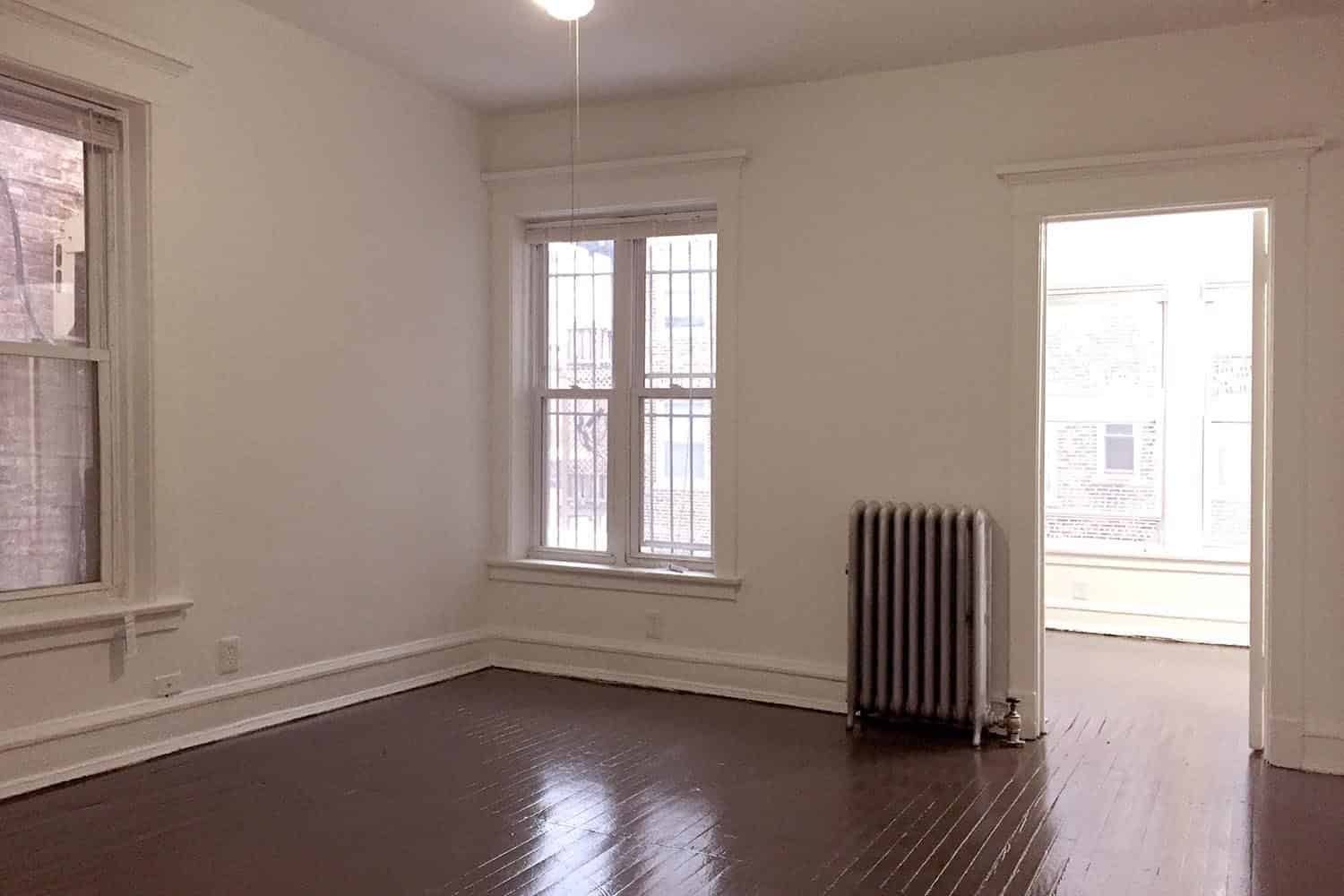
Housing options near UIC start at approximately $600 USD per month. The following budget bands are based on typical listings in 2026. All prices are indicative — confirm with the operator.
Economy Band: $600 – $900 per month
This range typically covers shared apartments, rooms in older buildings, or studios in less central neighborhoods. Examples include shared units in Pilsen or Bronzeville, where you might have a private bedroom with shared kitchen and bathroom. At the lower end, $600 might secure a room in a 3-4 bedroom apartment in a walk-up building without central air conditioning. At $900, you might find a small studio in the same areas.
In this band, expect older buildings (pre-1950 construction), window AC units, potentially shared laundry facilities. Commute times of 20-35 minutes via bus or train are common.
Mid-Range Band: $900 – $1,400 per month
This band covers most purpose-built student housing, newer apartment buildings, and well-maintained older units. A studio or one-bedroom apartment in Little Italy, University Village, or the Near West Side typically falls in this range. Shared two-bedroom units in the same neighborhoods split to $700-900 per person.
Buildings in this band often include in-unit laundry, dishwashers, fitness centers, and controlled access. Commute times of 10-20 minutes walking or 5-15 minutes by bus are typical.
Premium Band: Above $1,400 per month
Newer high-rise apartments near the Medical District or the South Loop, as well as luxury student residences, fall in this band. Expect amenities such as rooftop decks, 24-hour fitness centers, concierge service, parking, and high-speed internet included. Studios or one-bedroom units in these buildings may range from $1,400 to $2,000. Commute is often within 5-10 minutes walking distance.
Walk vs Transit Trade-Off
The decision between walking to campus and using public transit involves trade-offs in cost, time, and lifestyle.
Walking to Campus
Living within a 15-minute walk (approximately 0.75 miles) of UIC’s main campus limits your housing options primarily to Little Italy, University Village, the Near West Side, and the area immediately north of campus along Halsted Street. Rent in these areas tends toward the mid-range and premium bands, but you save on monthly transit costs (a CTA monthly pass costs $75 as of 2024, subject to change). Walking eliminates commute uncertainty — no delayed trains or buses — and provides built-in daily exercise.
The trade-off is that these neighborhoods can be louder, with more foot traffic and nightlife activity. Parking is expensive and limited, so car-free living is practical and recommended.
Using Transit
Living further from campus — in Pilsen, Bronzeville, Lincoln Park, Wicker Park, or even suburbs along Metra lines — can reduce monthly rent by $200-500 compared to campus-adjacent units. A CTA monthly pass (or paying per ride at $2.50 per ride with Ventra card) keeps transit costs manageable.
The trade-off is commute time. A trip from Bronzeville via the Green Line involves a 15-20 minute walk to the station, a 15-minute train ride, then a 10-minute walk to class — total 40-50 minutes one way. From Wicker Park on the Blue Line, it might be 25-30 minutes door to door. Students with early morning classes in winter may find these commutes less appealing.
Hybrid Approach
Many students combine walking and transit. For example, living in Pilsen allows a 15-minute bus ride or 30-minute walk to campus, offering flexibility. Living near the Blue Line provides quick downtown and airport access while still being within 20-30 minutes of campus.
The practical recommendation for new international students: consider starting with a walking-distance lease for your first semester, then exploring transit options once you understand Chicago’s neighborhoods and your own schedule.
Shortlist Logic Using Nearby Residences
The following residences appear in current listings near UIC as of 2026. Each represents a different housing profile. This is not a recommendation but a framework for evaluating similar options.
June Homes 60647
This property is located in the 60647 ZIP code, which covers the Logan Square and Humboldt Park neighborhoods — approximately 3-4 miles northwest of UIC. This is a transit-proximate location near the Blue Line’s Western or Logan Square stations, offering 20-30 minute commutes to campus via train. 60647 is a popular area for students and young professionals, with a lively dining and nightlife scene. Rent in shared units typically falls in the economy to mid-range bands.
For a student who values neighborhood character and nightlife access over campus proximity, and who is comfortable with a transit commute, June Homes 60647 is the model for this profile. The trade-off is that you cannot easily return to campus between classes, so your schedule should allow for blocks of on-campus time.
Prairie Shores Bronzeville
Located in the Bronzeville neighborhood south of the Stevenson Expressway, near 35th Street and King Drive. This is approximately 3 miles from campus, accessible via the CTA Green Line (35th-Bronzeville-IIT station) or bus routes #3 and #X3. Prairie Shores is a large apartment complex with multiple towers and a mix of student and professional tenants.
Bronzeville offers lower rental costs than neighborhoods closer to campus. The area has less retail density than Little Italy or Logan Square, but rent tends to fall in the economy band for shared units. Commute time via Green Line is approximately 30-40 minutes. This model suits a budget-conscious student who does not mind a predictable train commute and is comfortable in a quieter residential setting.
Tailor Lofts
This property name suggests a converted industrial or commercial building in the South Loop or Near West Side. Loft-style units typically appeal to students who want open floor plans and contemporary finishes. Location is critical here: if Tailor Lofts is within the 60607 ZIP code (Near West Side) or 60616 (Bridgeport/South Loop), it could be within walking distance (10-20 minutes) of campus.
Loft conversions often fall in the mid-range to premium bands, with rent higher than comparable traditional apartments. The value proposition is architectural character and typically newer interior systems. For a student who prioritizes aesthetics and walkability and is willing to pay for it, Tailor Lofts represents this category.
Scio At The Medical District
“Scio” appears to be a new-construction or recently built property near the Illinois Medical District, which borders UIC’s western edge. This location is directly adjacent to campus — a 5-10 minute walk to academic buildings. Properties in this area attract medical, dental, and health sciences students who need proximity to hospitals and research facilities.
Rent likely falls in the mid-range to premium bands due to new construction and proximity. Amenities such as in-unit laundry, gym, and controlled access are standard. The trade-off is noise from the Medical District and hospital operations. For a health sciences student, this location offers unmatched convenience.
The Buckingham
This property name suggests a traditional apartment building, possibly in the South Loop (near Michigan Avenue) or the Near West Side. If located in the South Loop, near Roosevelt Road, it would be approximately 1 mile from campus, a 15-minute walk or 5-10 minute Blue Line ride.
South Loop units typically fall in the mid-range band, with a mix of older and newer buildings. The area offers access to Grant Park, Museum Campus, and the lakefront, which are recreational amenities not available west of campus. For a student who values city-living amenities and is comfortable with a short transit commute or brisk walk, The Buckingham represents this option.
How to Use This Shortlist Logic
When evaluating any housing listing near UIC, ask these questions:
- What is the exact walking distance to my department building? (Google Maps walking time)
- What transit lines and stations are within a 10-minute walk? (CTA Blue Line, bus routes)
- What is the estimated monthly rent, and does it include utilities and internet?
- Is the lease year-round or academic-year? (Some student buildings offer 9-month leases)
- What is the typical commute time during peak hours?
- Is the area safe for walking at night?
Using the five listed properties as reference cases, you can categorize any new listing into one of these profiles: transit-proximate neighborhood, budget residential area, walkable loft district, campus-adjacent medical zone, or city-living corridor.
Frequently Asked Questions
How far in advance should I look for housing for the 2026 or 2027 academic year?
Leases in Chicago typically begin on May 1, June 1, August 1, or September 1 according to the university calendar. For a fall 2026 start, begin searching in March or April 2026 for August leases. For spring 2027, search in October or November 2026. The UIC Off-Campus Housing office publishes listings year-round. International students arriving with a 30-day lease start window may find reduced availability and higher prices. Start early and plan for temporary accommodation if needed.
What is the typical commute time from housing to UIC?
Walking distance housing (within 0.5 miles) yields a 5-10 minute walk. Transit commuting from neighborhoods 2-4 miles away generally takes 20-40 minutes one way. From farther neighborhoods like Logan Square or Bronzeville, 30-50 minutes is typical. The Blue Line from O’Hare to campus takes 45-60 minutes, making airport-area housing impractical for daily commutes.
Which neighborhoods are safest for UIC students?
Crime data and student reviews indicate that Little Italy, University Village, and the Near West Side directly adjacent to campus have lower reported crime rates than areas further south or west. The UIC campus itself has a visible police presence and emergency call boxes. The Near South Side (Prairie District) and South Loop also report lower crime. Pilsen and Bronzeville have higher overall crime rates but many student residents report positive experiences when living on main streets near transit. Always visit neighborhoods in person during both daytime and evening hours, and use the UIC Safe app or similar personal safety tools.
Data date: 2026. All rental prices are indicative — confirm with the operator.
See also: listing details · browse more