Barcelona Student Housing Guide: Neighbourhoods, Prices, and Booking Timeline
Barcelona is home to five major universities and a vibrant student population. As of 2026, the platform lists 189 student properties across the city, with monthly rents starting from €250 (indicative — confirm with the operator). This guide breaks down how the universities map to districts, what price ranges to expect, and the key pitfalls to avoid when searching for accommodation.
The five universities covered are:
- University of Barcelona (UB) – global rank 160
- Universitat Autònoma de Barcelona (UAB) – rank 172
- Universitat Pompeu Fabra (UPF) – rank 265
- Universitat Politècnica de Catalunya (UPC) – rank 392
- Universitat Ramon Llull (URL) – rank 436
Universities and Their Neighborhoods
Each university has a distinct campus location, which determines the most convenient residential areas for students.
University of Barcelona (UB) has its main campus in the heart of the city, in the Eixample district near Plaça Universitat. Some faculties are also located in the historic Ciutat Vella (Raval, Gotico). Students at UB typically look for housing in Eixample, Gràcia, or the southern part of Sarrià-Sant Gervasi for a balanced commute.
Universitat Autònoma de Barcelona (UAB) is the furthest from the city centre. Its Bellaterra campus is located about 20 km north-west of Barcelona, near Cerdanyola del Vallès. Students at UAB often live either close to campus in Cerdanyola or Bellaterra (quieter, lower rent) or in the northern districts of Barcelona (Nou Barris, Horta-Guinardó) that connect via the Ferrocarrils de la Generalitat train line. Commute time from central Barcelona to UAB is approximately 45–60 minutes.
Universitat Pompeu Fabra (UPF) has its main campus (Ciutadella) in the Ciutadella Park area, close to the beach and the Born neighbourhood. Another campus (Mar) is near the Barceloneta beach. UPF students often prefer the Born, Barceloneta, Sant Martí, or Poblenou districts, where walking or a short metro ride is possible.
Universitat Politècnica de Catalunya (UPC) has several campuses, but the main engineering campus (Campus Nord) is located in the Zona Universitària area in Les Corts district. Other faculties are in Terrassa or Castelldefels, but the largest student population studies at Campus Nord. Students at UPC typically live in Les Corts, Sarrià-Sant Gervasi, or nearby parts of Eixample.
Universitat Ramon Llull (URL) comprises multiple schools across the city. The main campus (La Salle) is in the Bonanova area of Sarrià-Sant Gervasi. Other schools are located in Pedralbes, Sant Gervasi, and the Gràcia district. Students at URL tend to look for housing in the upper part of the city: Sarrià-Sant Gervasi, Gràcia, and the north of Les Corts.
Price Bands and Budget Considerations
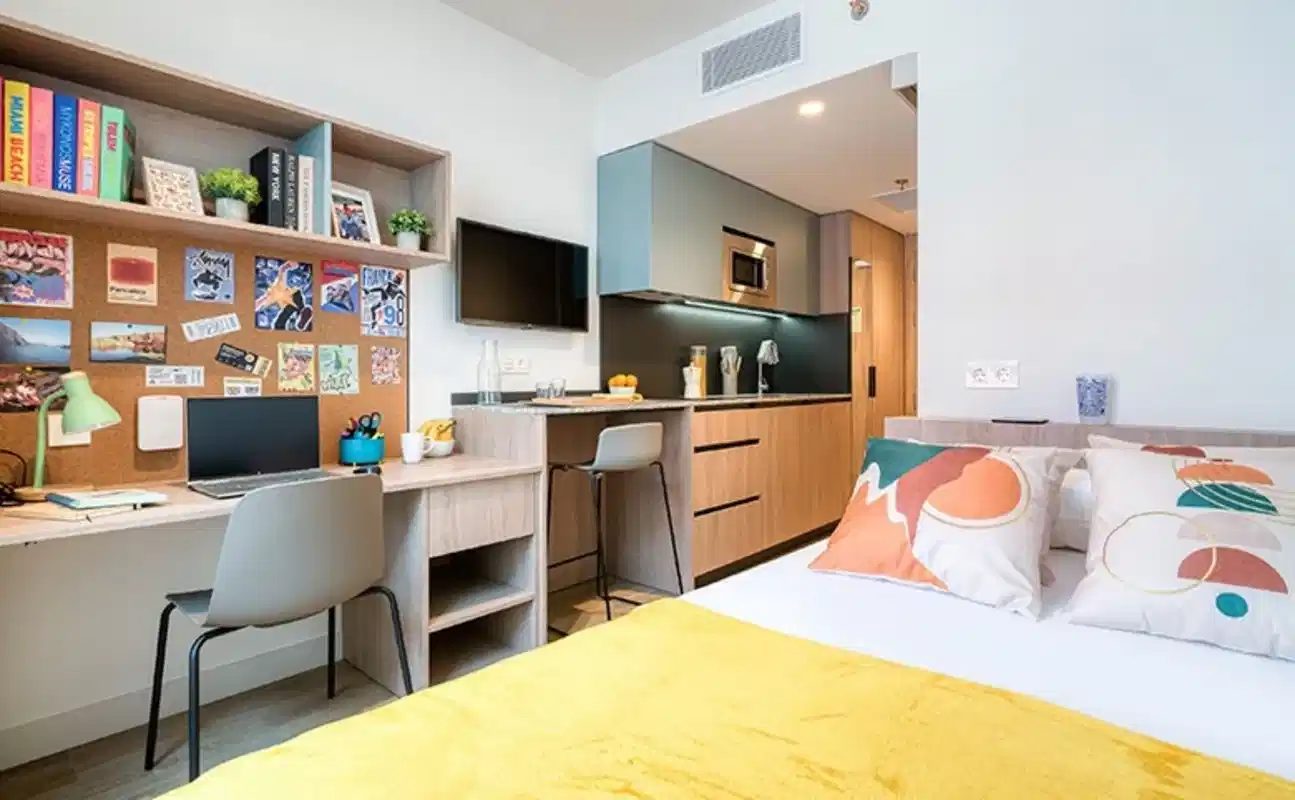
The platform’s minimum price of €250/month indicates entry-level shared rooms or small studios in outer districts. Prices vary significantly by location, property type, and season. Below is a practical breakdown based on typical 2026 rents (all indicative — confirm with the operator):
- €250 – €400 per month: Shared rooms in less central districts (Nou Barris, Horta-Guinardó, Cerdanyola, outer Sant Martí). Some single rooms in older buildings in the Raval or El Clot may also fall in this range.
- €400 – €600 per month: Shared flats in central areas (Eixample, Gràcia, Les Corts, Poblenou). A private room in a shared apartment in the city centre typically costs €450–€550.
- €600 – €900 per month: Studio apartments or private one-bedroom flats in Eixample, Gràcia, Sarrià-Sant Gervasi, or Born. Supply is tighter at this level.
- €900 and above: High-end studios, luxury shared flats, or entire apartments in the most desirable zones (Pedralbes, Diagonal Mar, Gothic Quarter tourist areas). Most students avoid this bracket unless sharing with roommates.
Keep in mind that many student residences (often operated by private companies) charge by the month with all utilities included, while private rentals require separate utility bills. Always verify whether the listed price includes water, electricity, gas, and internet.
Commute Logic: Choosing a Neighborhood
When selecting a neighborhood, the primary factor is your university’s location and your tolerance for commute time. Below is a logic based on each university.
-
For UB and UPF students – prioritize central districts. Eixample (especially the left and right parts) offers metro lines L1, L3, L5 that connect quickly to both UB and UPF. Gràcia is slightly more relaxed and close to UPF’s Mar campus. Born and Barceloneta are excellent for UPF students but can be tourist-heavy. Average commute: 15–25 minutes by metro or walking.
-
For UPC and URL students – focus on the upper side of the city: Les Corts, Sarrià-Sant Gervasi, and the western half of Gràcia. These neighborhoods have direct access to UPC’s Campus Nord via the L3 metro or bus lines. For URL’s La Salle campus, the Bonanova area (FGC train station is a plus) is ideal. Average commute: 20–30 minutes.
-
For UAB students – the most important factor is proximity to the FGC line (S1, S2) that serves the Bellaterra campus. Students living near FGC stations in Barcelona (e.g., Plaça Catalunya, Gràcia, Sarrià or the Av. Tibidabo station) can commute in 30–60 minutes. Cheaper housing is available in Cerdanyola or Bellaterra itself, but these are suburban towns with fewer amenities and limited nightlife.
-
For students who value nightlife and social life – the compact city centre (Raval, Gothic, Born, Gràcia) is ideal, but be prepared for higher rents, noise, and occasional petty crime. If you are at UB or UPF, these areas are perfect. For UAB or UPC students, the extra commute time may be worth it if you want to be close to the action.
-
For students on a tight budget (below €400) – consider outer districts like Nou Barris, Horta-Guinardó, or Sant Andreu. These are well-connected by metro lines L1, L4, or L5. From Nou Barris, you can reach UB in about 30 minutes and UPC in 35 minutes. UAB is also accessible via L3 to Plaça Catalunya and change to FGC.
Three Common Pitfalls
-
Short-term vs long-term lease confusion – Many private landlords in Barcelona prefer 11-month contracts (temporary rental) rather than standard one-year agreements. This is common and legal, but make sure the contract clearly states the duration and notice period. For student residences, contracts are usually per academic year (September to June). Always read the cancellation policy before signing.
-
Scams and fake listings – Barcelona has a high rate of accommodation scams targeting international students. Red flags include: a landlord asks for deposit before you have seen the property (or via an online platform that is not escrow), the price is significantly below market average (e.g., €300 for a single room in Eixample), or the listing uses professional photos that seem too good. Always request a video call or have someone local view the property in person. Use the platform’s verified listings where possible.
-
Tourist rental pressure – Some areas (Gothic, Born, Barceloneta, Raval) have many apartments converted into short-term holiday lets, driving up rents and reducing availability for students. In these zones, supply of long-term student housing is limited and you may need to start searching 3–4 months in advance. Additionally, if you find a flat that seems to be advertised as a “tourist apartment” off-season, check the licence number; renting a tourist flat as a long-term tenant may be illegal and you could be evicted.
Booking Calendar Timeline
For the 2026–2027 academic year, the typical search and booking timeline is as follows.
- January – February: Start researching neighborhoods and budget. Check platform listings to understand price trends. If you are planning to apply for a student residence (operated by a company), applications often open in February.
- March – April: Begin contacting landlords or residence operators. Many private student residences release rooms for the next academic year in April. For shared flats, listings appear closer to the move-in date.
- May – June: Peak booking period. Most student housing contracts start in September. By the end of June, about 70% of available rooms are already taken. Be prepared to pay a deposit (usually one month’s rent) and possibly agency fees.
- July – August: Last-minute search. You can still find rooms, but the selection is smaller and prices may be higher. Some students who cancel their bookings free up rooms. Be cautious of scams during this period.
- September – October: Move-in month. If you arrive without housing, you can try short-term sublets (1–2 months) while searching for a long-term place. Avoid signing a contract sight unseen if possible.
Note: Many student residences require you to book 4–6 months in advance for the best rates. For private rentals, the most reliable listings appear 1–3 months before the start date. Start your search as early as February for a smooth experience.
Frequently Asked Questions
Q1: Is €250 per month a realistic price for student housing in Barcelona?
€250 per month is at the very low end. It typically corresponds to a shared room (not a private room) in an outer district like Nou Barris or Cerdanyola, or a small room in a very old building in the Raval. Most private rooms in central areas cost €400–€600. Always confirm exact inclusions (utilities, internet) with the operator. The price is indicative and may change.
Q2: Which is the best neighborhood for a student at Universitat Autònoma de Barcelona (UAB)?
If you want to be close to campus, live in Cerdanyola del Vallès or Bellaterra — rents are lower and commute is 10 minutes by foot or bike. If you prefer Barcelona city life, choose a neighborhood near an FGC station: Sarrià, Gràcia, or Plaça Catalunya. Expect a 45–60 minute commute each way.
Q3: Can I book student housing in Barcelona from my home country before arriving?
Yes, many platforms allow remote booking. However, only book through verified channels (reputable student housing portals, official residence websites). For private rentals, request a video tour and avoid paying any deposit via non-traceable methods (cash, Western Union). A written contract with a Spanish tax ID (NIF) is essential.
Q4: How many properties are available on the platform, and how quickly do they sell out?
The platform lists 189 properties in Barcelona as of 2026. This includes student residences, shared apartments, and studios. During peak season (May–June), popular listings in central areas may receive multiple inquiries within days. It is common for a well-priced room in Eixample or Gràcia to be rented within 48 hours. Start your search early and have your documents ready (passport, student enrollment letter, proof of income or guarantor).
Data update: April 2026. Prices and property counts are based on platform listings at that time and are indicative — confirm with the operator before booking.
See also: listing details · browse more