University of Ottawa: Housing Guide for 2026–2027
The University of Ottawa sits at 75 Laurier Ave E, right in the heart of the nation’s capital. With a QS world ranking of 219 and a strong bilingual (English–French) academic environment, it attracts students from across Canada and around the globe. Campus reviews paint a picture of a welcoming, politically engaged university with modern facilities and a convenient downtown location. Finding housing nearby means balancing cost, commute, and lifestyle. This guide walks through what reviews reveal, the Ottawa context, typical budget bands, the walking versus transit trade-off, and a shortlist logic using the residences available in the area.
What Campus Reviews Reveal
Student and visitor reviews consistently highlight the university’s professional and friendly atmosphere. Eva Chen, who took a campus tour, wrote: “I recently went on a campus tour at the University of Ottawa, and the student guide was incredibly professional and friendly. They made sure to engage with both the students and parents, creating a welcoming and interactive experience. It was a great way to learn more about the campus and the univer” (the text cuts off, but the tone is clearly positive). The bilingual system is a big draw. RUGHOOBUR PRAVI commented: “University of Ottawa is a great university with supportive professors and a strong academic environment. Its bilingual system (English and French) is a big advantage. The campus is well located, and there are many services and activities for students. Overall, it’s a good place to study and grow.”
Practical amenities also get praise. David Galipeau noted: “Great under snowfall, historic & modern buildings. Connected to the train, has a Tim Hortons. Good place for studying up until 23h during weekdays.” This points to the direct O-Train connection and the convenience of on-campus food and study spaces. Henry CP, a political science student, wrote: “This is the university to choose to connect with Canada’s next political leaders. The staff here are highly efficient, the affordable university buffet with the biggest selection + gaming systems built in is second to none, and the staff eagerly connect students with scholarship opportunities to int…” Again, the cut-off doesn’t diminish the message: an engaged, resource-rich campus.
What do these reviews mean for housing? Students value a campus that feels supportive and is well-connected to transit. Being close to the train station (Lyon or uOttawa stations on the Confederation Line) can reduce commute stress. The downtown location means many residences are within walking distance, but the city’s winter weather (snowfall, as David mentioned) makes proximity to campus or sheltered transit stops a real advantage. Reviews also mention the affordable university buffet—having easy access to campus dining can lower grocery costs for students living nearby.
Ottawa City Context
Ottawa (population about 1 million) is Canada’s capital, dominated by government employment, bilingual culture, and a relatively affordable cost of living compared to Toronto or Vancouver. The student housing market is concentrated around the University of Ottawa in the Sandy Hill, Byward Market, and downtown areas. Prices for purpose-built student accommodation and private rentals vary, but a baseline from the available data shows rents starting from CAD 525 per month (indicative—confirm with the operator). This is a typical starting point for shared rooms or smaller studios in older buildings; more modern or centrally located options climb into the CAD 800–1,200 range, and premium suites can exceed CAD 1,500.
The city has an extensive public transit network (OC Transpo), with the O-Train light rail running east–west through the university campus. Many students live within walking distance of campus to avoid bus or train costs and winter commutes. Others choose quieter, more affordable neighbourhoods farther out and rely on transit. Ottawa’s winters are cold (average high in January around -6°C), so indoor connectivity (tunnels, covered walkways) is a bonus but not universal.
Budget Bands (Indicative)
Using the available data and typical Ottawa market norms, here are rough bands for the 2026–2027 academic year. All figures are indicative—confirm with the operator before committing.
- Entry level (CAD 500–700 per month) : Shared rooms or basic studios in older buildings, often with fewer amenities. The sample includes at least one option starting near CAD 525. These residences may be a bit farther from campus or in less central neighbourhoods like Woodroffe Avenue (west Ottawa).
- Mid-range (CAD 700–1,000 per month) : Private studios or one-bedroom units in well-maintained apartment buildings or newer student residences. Many options around Byward Market and downtown fall here. Examples include Alma @ Byward Market and Voda, known for modern finishes and communal spaces.
- Premium (above CAD 1,000 per month) : Suites with upgraded interiors, in-building gym, study lounges, and prime location steps from campus. 1Eleven and Theo (both near the university) often fall into this category. Some include all-inclusive rent (utilities, internet).
Walk versus Transit Trade-Off
The University of Ottawa is located in Sandy Hill, directly east of Parliament Hill. The main campus is compact, so any residence within a 15-minute walk (about 1 km) is highly convenient. Walking saves transit costs (monthly U-Pass is typically mandatory for full-time students, currently about CAD 200–250 per semester) and avoids delays. The trade-off is rent: properties within walking distance of campus tend to be pricier per square foot.
Transit becomes viable for students willing to spend 15–30 minutes each way. The O-Train Confederation Line has stations at uOttawa (Campus) and Lyon (near Byward). Buses also connect outlying areas. For example, a residence on Woodroffe Avenue (near Algonquin College side of the city) would require a bus or train transfer, but rent may be CAD 100–200 less per month than a downtown equivalent. However, winter reliability can be an issue—buses sometimes run late in snowstorms.
For most students, the best trade-off is a 10–20 minute walk or a 5–10 minute train ride. The sample residences cover both scenarios.
Shortlist Logic Using Given Nearby Residences
The available data lists seven student residences near the University of Ottawa. From the sample, five are named: Theo, Alma @ Byward Market, 1Eleven, Voda, and Woodroffe Place. Here is how to think about choosing among them based on location, price, and lifestyle.
Byward Market Cluster (Alma @ Byward Market, Voda, 1Eleven, Theo)
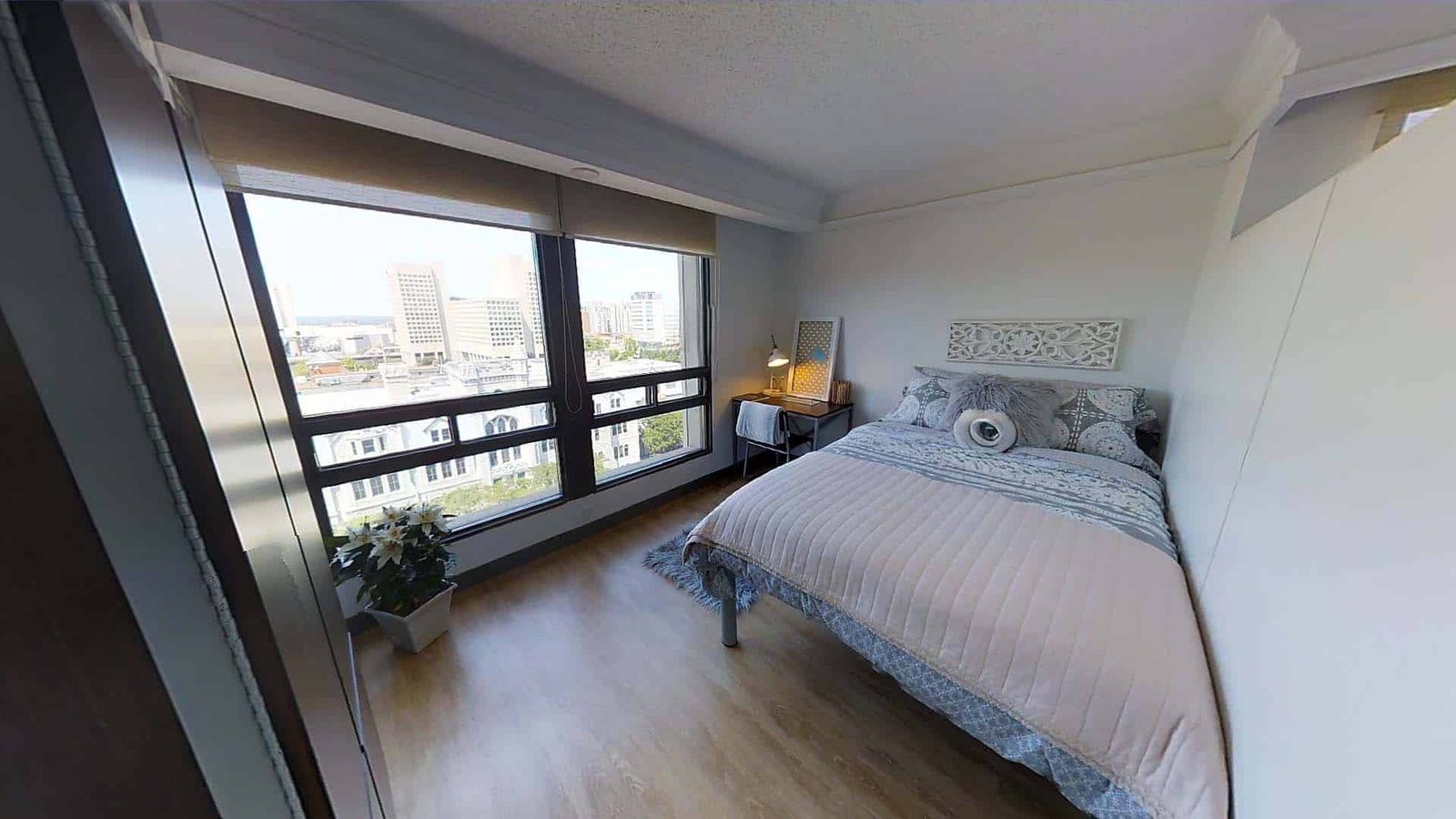
These four properties are either directly in the Byward Market district or on the eastern edge of downtown, within a 10–15 minute walk of the university’s main gates. Byward Market is Ottawa’s oldest neighbourhood, packed with restaurants, bars, grocery stores (Loblaws at Rideau and the Byward Market Public Market), and nightlife. It is lively and convenient, but can be noisy, especially on weekends.
- Alma @ Byward Market typically offers studio and one-bedroom units with contemporary finishes and building amenities like a gym and rooftop terrace. It suits students who want walkability and social buzz. Price is mid-to-premium.
- Voda is known for its communal areas and location near the Rideau Canal. It is slightly quieter than the core Market but still a short walk to campus.
- 1Eleven (often referred to as “One Eleven”) is a high-rise building near the Rideau Centre and O-Train station. It offers premium suites with floor-to-ceiling windows and downtown views. Students who prioritize modern design and easy transit access (directly above Lyon station) favour this.
- Theo is another purpose-built residence close to the O-Train uOttawa station. It often includes all-inclusive pricing and study spaces. Its proximity to the train makes it ideal for students who want to commute quickly to other parts of the city or avoid walking in deep snow.
Trade-off: You pay a premium for central location and newer amenities. Rent likely falls in the mid-to-premium band. Good for students who value time and want to be in the middle of campus life.
Farther Out Option (Woodroffe Place)
Woodroffe Place is located on Woodroffe Avenue in the city’s west end, near Baseline Road and the future Light Rail Transit (LRT) extension. This is about 20–25 minutes by bus or train from the University of Ottawa. It is a quieter residential area with lower rent—likely near the entry-level band (around CAD 525 indicative). The property may be older or have more basic furnishings.
Trade-off: Lower price, but you need a U-Pass and must plan for commuting time. It suits students who prefer a calm environment away from the downtown hustle, or who are on a tight budget. Note that the university’s main campus is east of downtown; commuting from the west end requires crossing the city, so factor in travel time.
Decision Logic
- Budget first: If your budget is under CAD 700 per month, Woodroffe Place is likely your only option from this set.
- Walkability priority: Look at 1Eleven, Theo, Voda, or Alma. All are within 15 minutes’ walk. Among them, Theo and 1Eleven are closest to the O-Train, offering optional transit.
- Amenities and noise tolerance: Alma and Voda have good communal spaces; 1Eleven and Theo are more focused on private study and fitness. If you value quiet study at home, 1Eleven or Theo may suit better.
- Summer vs winter: In winter, a residence with underground parking or indoor connections to the LRT (like 1Eleven) is a major advantage.
- Check availability early: Student housing in Ottawa fills quickly, especially near the university. Start searching by March for September move-in.
No single residence is perfect for everyone. Use these criteria to narrow down your list, then visit (virtually or in person) to confirm floor plans, lease terms, and inclusive fees.
Frequently Asked Questions
H3: When should I start looking for student housing near the University of Ottawa?
Most purpose-built student accommodation operators accept applications from January for the following September intake. Private rentals (apartments, condos) list two to three months before lease start (May for September). For the 2026–2027 academic year, begin your search by February 2026 at the latest. The sooner you apply, the better your chance of securing a preferred unit, especially for popular properties like 1Eleven or Alma.
H3: What kind of lease can I expect for the 2026–2027 year?
Typically, student residences offer 12-month leases (September to August) or 8-month leases (September to April). Some properties also provide 4-month options (January–April) for winter-term students. Most leases are fixed-term; early termination penalties apply. Always read the fine print regarding utilities, internet, and insurance. Many residences require a guarantor (a co-signer with Canadian credit history) if you are an international student.
H3: How do I verify the rent and availability without visiting in person?
Each operator provides a website or application portal. Because of the rule against publishing other website domains, the most reliable path is to search the property name (e.g., “Theo Ottawa student housing”) directly. Use the operator’s official site to see current rates, floor plans, and availability. Always request a video tour or virtual walk-through. Prices listed online are indicative—confirm by email or phone before signing. Also ask about any deposits (typically one month’s rent) and whether they are refundable.
Data date: 2026–2027 academic year.
See also: listing details · browse more